
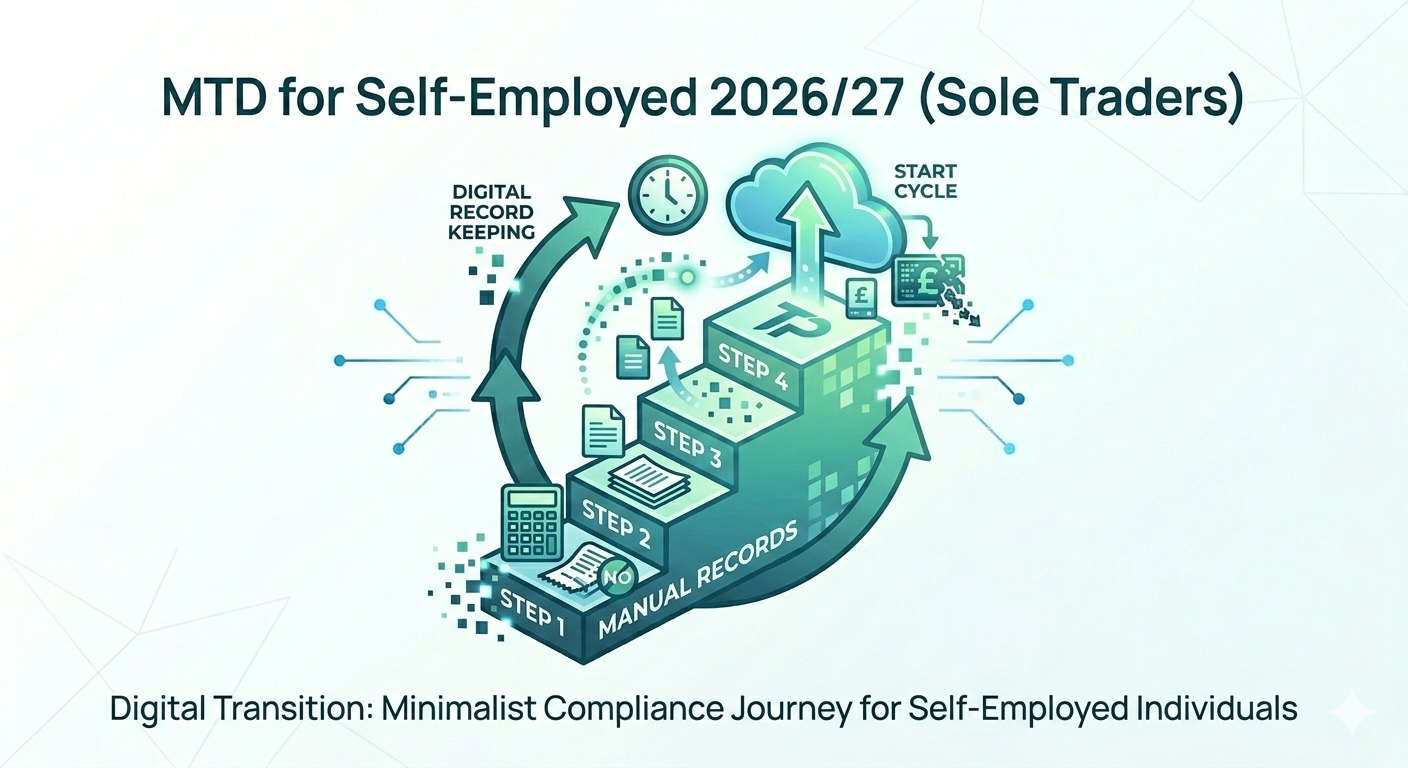
TL;DR
- From 6 April 2026, self-employed individuals earning £50,000+ gross income must comply with MTD.
- From April 2027, the threshold drops to £30,000.
- You must keep digital records and submit quarterly updates.
- A final year-end declaration is still required.
- Early preparation avoids penalties and admin chaos.
Introduction
For decades, self-employed professionals have operated under one familiar system: file a Self Assessment tax return once a year and pay what’s due by 31 January.
That system is changing.
From April 2026, Making Tax Digital (MTD) for Income Tax becomes mandatory for thousands of sole traders across the UK. Instead of filing annually, you’ll report income and expenses every quarter using approved software.
This isn’t a small tweak.
It’s the biggest structural shift to self-employed tax reporting in a generation — introduced by HM Revenue & Customs under the wider Making Tax Digital initiative.
If you’re self-employed and earning over £50,000, you are now in scope.
Here’s exactly what that means — and what you must do before the 2026/27 tax year begins.
What Is Making Tax Digital (MTD)?
Making Tax Digital is a government reform programme designed to modernise tax reporting.
For the self-employed, it replaces the traditional annual Self Assessment model with:
- Digital record-keeping
- Quarterly income and expense updates
- A final year-end declaration
The aim?
Greater accuracy.
Fewer surprises.
More real-time tax visibility.
But in practice, it means more frequent compliance responsibilities for sole traders.
Who Must Comply in 2026/27?
From 6 April 2026, MTD for Income Tax applies if:
- You are self-employed, and
- Your gross business income exceeds £50,000
Gross income means total revenue before expenses.
If your income exceeded £50,000 in either:
- 2024/25, or
- 2025/26
You will enter MTD in the 2026/27 tax year.
The 2027 Expansion
From April 2027, the threshold drops to:
£30,000 gross income
This significantly expands the number of sole traders affected.
If you’re earning between £30,000 and £49,999, your preparation window is shorter than you think.
How MTD Changes Self-Assessment
Under the old system:
- Keep records (often spreadsheets or paper)
- File one annual tax return
- Pay tax twice yearly (payments on account)
Under MTD:
- Keep digital records continuously
- Submit updates every quarter
- Submit a final declaration at year-end
You’re moving from one compliance event per year…
to five.
That’s a major operational shift for many sole traders.
What You Must Do Under MTD
Let’s break this down into practical steps.
1. Keep Digital Records
You must maintain digital records of:
- Sales income
- Business expenses
- Dates of transactions
- Business categories
Manual paper records are not compliant.
Spreadsheets are only compliant if digitally linked to submission software (no copy-paste submissions).
2. Use MTD-Compatible Software
You must submit via approved software.
Look for:
- Direct HMRC integration
- Quarterly submission capability
- Expense categorisation tools
- Bank feeds
- Audit trail functionality
Basic bookkeeping tools without MTD functionality will not qualify.
Choosing the right system early prevents disruption later.
3. Submit Quarterly Updates
You will submit four quarterly reports covering:
- April–June
- July–September
- October–December
- January–March
Each update summarises:
- Total income
- Total allowable expenses
It is not a full tax calculation — but accuracy matters.
Deadlines are typically one month after quarter end.
4. Submit a Final Declaration
At the end of the tax year, you must:
- Confirm final figures
- Include other income (employment, dividends, property)
- Finalise tax liability
This replaces the traditional Self Assessment return.
So annual reconciliation still exists — it’s just structured differently.
MTD Deadlines for 2026/27
For quarterly filers:
- Q1 deadline: 5 August 2026
- Q2 deadline: 5 November 2026
- Q3 deadline: 5 February 2027
- Q4 deadline: 5 May 2027
Final declaration:
- 31 January 2028
Missing these deadlines triggers the points-based penalty system.
Consistency is essential.
MTD Penalties: How the Points System Works
Under MTD, late submissions earn penalty points.
For quarterly filers:
- Each late submission = 1 point
- Once you reach the points threshold, a £200 fine applies
- Additional fines apply for continued non-compliance
Points only reset after a full compliance period.
Unlike the old system, repeated small delays accumulate risk.
Common Mistakes Sole Traders Will Make
- Waiting until April 2026 to set up software
- Assuming quarterly reporting means quarterly tax payments
- Not separating personal and business accounts
- Ignoring allowable expense optimisation
- Failing to review business structure
MTD is administrative.
But it exposes strategic inefficiencies.
This is an opportunity — not just an obligation.
Should You Review Your Business Structure?
MTD increases reporting visibility.
For some sole traders earning £50,000+, this is the right time to ask:
- Should I incorporate?
- Am I optimising NIC?
- Would salary/dividend planning reduce tax?
- Is VAT registration becoming relevant?
MTD doesn’t change tax rates.
But it changes reporting discipline — and that highlights planning gaps.
Key Takeaways
- MTD for self-employed begins April 2026 for £50k+ earners
- Threshold drops to £30k in April 2027
- Digital records and quarterly submissions are mandatory
- Final year-end declaration replaces Self Assessment
- Penalty points accumulate quickly
- Early software setup reduces stress
- This is a compliance shift — but also a planning opportunity
Final Thoughts
Making Tax Digital for the self-employed in 2026/27 is not just another compliance update.
It’s a structural shift in how sole traders interact with the UK tax system.
Quarterly submissions will require:
- Better bookkeeping discipline
- Stronger financial visibility
- Earlier preparation
Those who prepare now will find the transition manageable.
Those who delay risk penalties, rushed software adoption, and avoidable stress.
April 2026 is closer than it feels.
Prepare Before April 2026
If you’re unsure whether you fall within the £50,000 threshold — or whether your current structure is still tax-efficient — review your position now and implement a compliant system before the first quarterly deadline arrives.
Leave a Reply